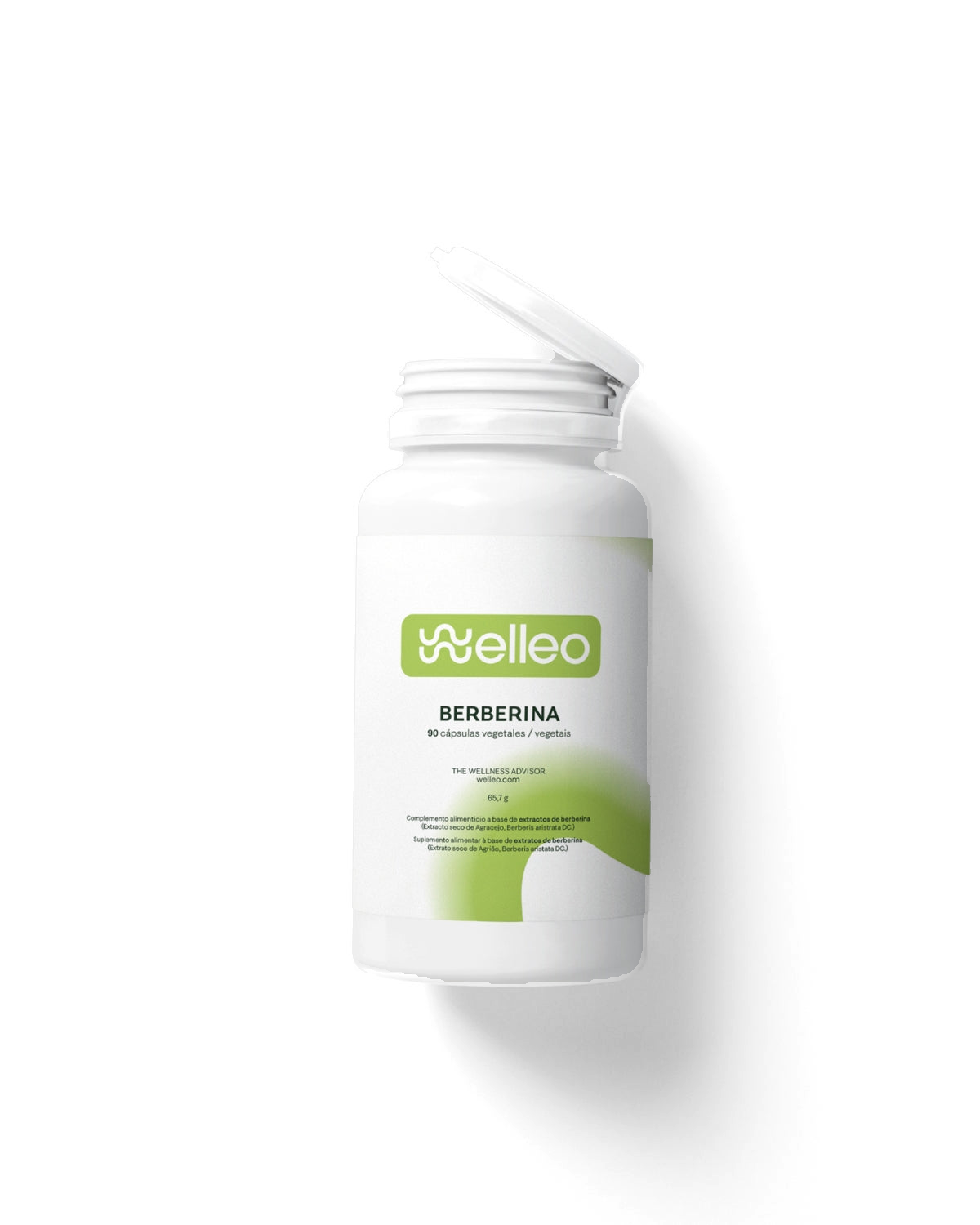

Food supplement
Berberine
- Free shipping from 39€
- Delivery 48–72 h · Iberian Peninsula
- Easy returns within 30 days

About the formula
Berberis aristata root bark. Standardised to 97% berberine (HPLC).
Berberine is an alkaloid found in the root bark of Berberis aristata, a shrub native to the Himalayas. Welleo uses a standardised dry extract at 97% berberine, measured by laboratory assay (HPLC).
Each capsule contains 500 mg of extract, of which 485 mg is berberine. The full composition and the recommended intake are declared below. Read them, and speak to your doctor or pharmacist before you start.
Targeted benefits
What it helps with
-
Blood glucose
Berberis aristata root bark helps improve blood glucose control.
-
Plasma triglycerides
Berberis aristata contributes to the control of plasma triglyceride levels.
-
Liver
Berberis aristata root supports liver health.
How to take it.
-
Daily dose
1 to 3 capsules per day, providing 500 mg to 1,500 mg of Berberis aristata root bark extract (485 mg to 1,455 mg of berberine). Start at 1 capsule and increase only on professional advice.
-
When to take it
15 to 30 minutes before your main meal.
-
How to take it
With half a glass of water (about 125 ml).
-
Before you start
Speak to your doctor or pharmacist before taking this product, in particular if you take any prescription medication.
Key ingredients
Meet the ingredients.
-
Berberine
An alkaloid from the root bark of Berberis aristata, standardised to 97%.
- Source
- Berberis aristata root bark — Himalayan shrub
- Form
- Standardised dry root bark extract, 97% berberine (HPLC)
On the label
Everything on the label.
| Nutrient | Per serving |
|---|---|
| Barberry root bark dry extract (97% berberine) | 500 mg / 1,500 mg |
| Of which: Berberine | 485 mg / 1,455 mg |
- Format
- Bottle of 90 vegetable capsules (730 mg each).
- Ingredients
- Barberry root bark dry extract (97% berberine, Berberis aristata D.C.), capsule (coating agent: hydroxypropyl methylcellulose, water and gelling agent: gellan gum), bulking agent (microcrystalline cellulose), anti-caking agent (magnesium salts of fatty acids) and bulking agent (calcium phosphate).
- Dietary notes
- Gluten-free. Suitable for vegans.
Warnings
The beneficial effects stated for this product are obtained with a daily intake of 2 capsules. Do not exceed the recommended daily dose. Food supplements should not be used as a substitute for a varied and balanced diet or a healthy lifestyle. Keep out of reach of young children. Not recommended during pregnancy or breastfeeding, or for children and adolescents. Not recommended if you have diabetes, low blood pressure, or a liver or heart condition. Berberine may lower blood sugar and blood pressure. Do not take it alongside prescription medication — in particular medication for diabetes or blood pressure, immunosuppressants, or medicines metabolised by the liver — without medical supervision. Stop taking it and seek medical advice if you notice yellowing of the skin or eyes, dark urine, or persistent abdominal pain. Store in a cool, dry place, tightly closed, below 30 °C.
Transparency
Questions before you start.
What is berberine, and where does ours come from?
Berberine is an alkaloid that occurs naturally in several plants. Ours is extracted from the root bark of Berberis aristata, a shrub from the Himalayas, and standardised to 97% berberine, measured by laboratory assay (HPLC). Each capsule contains 500 mg of that extract, of which 485 mg is berberine.
When should I take it?
Our label recommends taking it 15 to 30 minutes before your main meal, which is the intake pattern used in the published literature on this ingredient. If your doctor or pharmacist advises something different, follow their advice rather than ours.
Are there any safety limits or contraindications?
Yes, and they matter. Do not take this product if you are pregnant or breastfeeding, and do not give it to children or adolescents. It is not recommended if you have diabetes, low blood pressure, or a liver or heart condition. Berberine may lower blood sugar and blood pressure and interacts with many prescription medicines, including those for diabetes and blood pressure, immunosuppressants, and medicines processed by the liver — speak to your doctor or pharmacist before you start. Stop taking it and seek medical advice if you notice yellowing of the skin or eyes, dark urine, or persistent abdominal pain.
What does HPLC mean?
HPLC stands for high-performance liquid chromatography. It is a standard laboratory method for measuring exactly how much of a given compound is in a sample: the material is dissolved and pushed through a column that separates its components, and a detector measures each one as it comes out. When a page here says an extract is standardised to a certain percentage (HPLC), that is the method behind the number — the concentration is measured in a lab, not estimated from the plant.
Is berberine under review in Europe?
Yes. EFSA published a draft opinion on berberine in January 2026 and was not able to establish a safe intake level; the final opinion is expected in early 2027, after which the European Commission will decide whether to restrict it. Rules already differ by country — Belgium, for example, sets a much lower maximum than Spain. We are following the process and will update this page as it develops.