Skip to product information
1 of 1

Estradiol Test

Measure estradiol levels with precise digital analysis.

Duties and taxes included. Shipping calculated at checkout.
Only for Professional Use
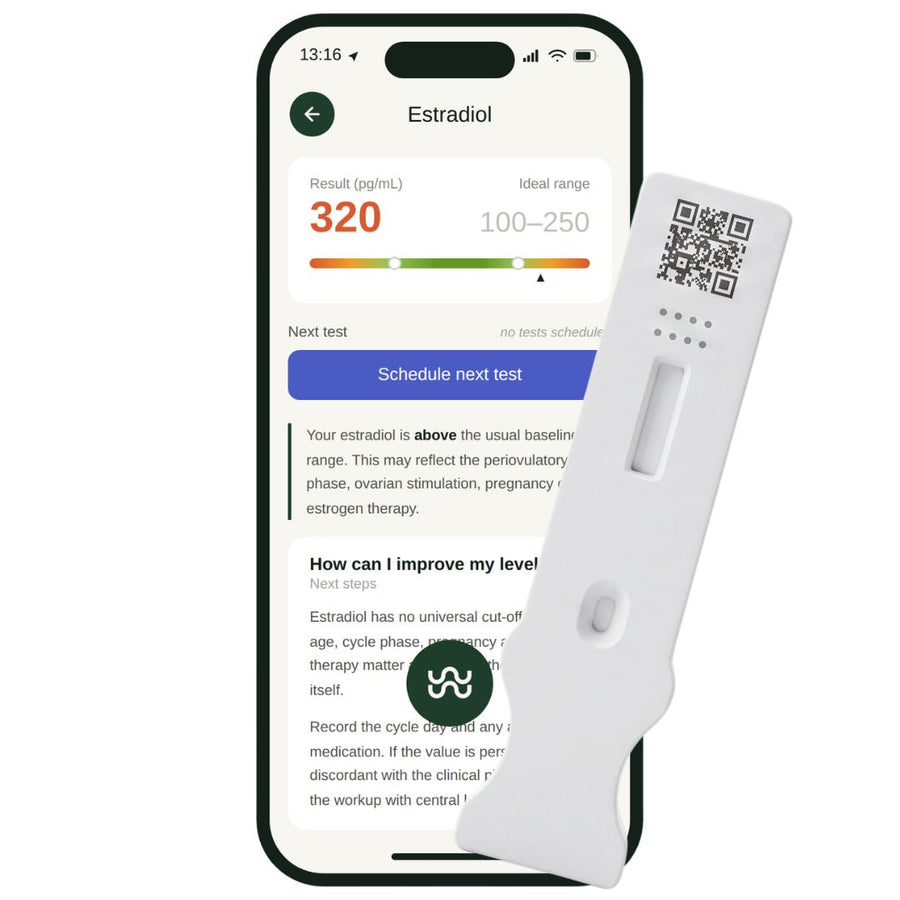
The Welleo Estradiol test accurately measures estradiol levels from blood samples using fluorescence immunoassay technology. Digital reading ensures reliable data for reproductive and endocrine monitoring.
View full details

Technical product

Estradiol Test

Description

Estradiol is a key estrogen hormone essential for evaluating ovarian function and monitoring follicular development, particularly in reproductive health assessments. In non-pregnant women, estradiol is primarily secreted by ovarian granulosa, theca, and luteal cells, while during pregnancy, the placenta becomes the main source. Once in circulation, approximately 1–3% of estradiol remains unbound, around 40% binds to sex hormone-binding globulin (SHBG), and the remainder binds to albumin. Estradiol plays a central role in regulating the growth of female reproductive organs and the development of secondary sexual characteristics. Its concentration varies throughout the menstrual cycle. Levels are low and stable during the early follicular phase, begin to rise around day seven as dominant follicles form, and peak just before ovulation. This peak suppresses follicle-stimulating hormone (FSH) and triggers a surge in luteinizing hormone (LH), leading to ovulation approximately 24 to 36 hours later. During the luteal phase, estradiol levels rise again, reaching their highest point about eight days after ovulation. If fertilization does not occur, estradiol levels decline, initiating a new menstrual cycle. Elevated estradiol levels may also result from primary or secondary ovarian hyperfunction. High estradiol concentrations are common during ovulation induction and pregnancy in assisted reproductive therapies. Conversely, low levels may indicate impaired ovarian synthesis due to primary ovarian failure, such as menopause, or secondary dysfunction related to hypothalamic-pituitary axis disorders. In males, estradiol levels are normally very low; elevated levels may result from increased aromatization of androgens and can lead to gynecomastia.

Reference Values:

Sex | Phase | Reference Range (ng/L) | Male | - | < 43.2 | Female | Follicular | 12.3 – 232.3 | Ovulation | 41.1 – 398.2 | Luteal | 22.3 – 340.3 | Menopausal | 5.0 – 137.4

Due to variations in geography, ethnicity, age, and gender, it is recommended that each laboratory establish its own reference intervals.

Intended use

The Estradiol (E2) Rapid Quantitative Test Kit is intended for in vitro quantitative determination of Estradiol (E2) in human serum, plasma, whole blood and peripheral blood. This test may assist in monitoring conditions associated with estradiol levels and contribute to the functional diagnosis of the reproductive system.

Principle

This kit utilizes the sandwich principle and fluorescence immunochromatography analysis technology to quantitatively detect the concentration of E2 in human serum, plasma, whole blood and peripheral blood.

The test uses anti-human estradiol monoclonal antibody conjugated with fluorescent latex, which is coated at the junction of the nitrocellulose membrane and the sample pad, and estradiol antibody is coated on the test line. After the sample is applied to the test strip, estradiol in the sample will bind to the fluorescent latex-labeled anti-human estradiol monoclonal antibody to form a labeled antigen-antibody complex. The complex moves to the detection zone by capillary action and is then captured by the estradiol antibody on the test line. The fluorescence intensity of the test line is proportional to the amount of estradiol in the sample. The concentration of E2 in the sample is determined through testing and analysis by the Welleo Rapid Test Reader.

Technical dossier

Laboratory and clinical details

Materials provided
  • Main components (ref. SF410255, SF410265, SF410256, SF410266, SF410257, SF410267):
  • The product is mainly composed of the following items:
  • Test cartridge | 15 tests | Detector Buffer | 15 units | Whole blood sampler | 15 units | Lancet | 15 units | Alcohol pad | 15 units | Biohazard bag 15 units | Instructions for use | 1 unit |
  • Note: The components of the different batches of kits are not interchangeable.
Materials needed but not provided
  • - Welleo Lateral Flow Reader (ref. Q1A-DUO-USB)
  • - Centrifuge (for Plasma/Serum only)
  • - Transfer pipette set (100 μL size)
  • - Specimen Collection Containers
Sample collection and preparation
  1. The test can be performed using serum, plasma, whole blood, or peripheral blood specimens.
  2. Whole Blood Collected by Venipuncture
  3. - Collect a whole blood specimen via venipuncture using standard phlebotomy procedures. Use a blood collection tube containing a suitable anticoagulant (EDTA is recommended).
  4. - It is recommended to test specimens immediately after collection. Do not leave specimens at room temperature for extended periods. If immediate testing is not possible, specimens may be stored at 2°C to 8°C.
  5. - Whole blood specimens stored at 2°C to 8°C for more than 2 days are not suitable for testing.
  6. Serum and Plasma
  7. - Separate serum or plasma from the blood as soon as possible to avoid hemolysis.
  8. - Testing should be performed immediately after specimen collection. Do not leave specimens at room temperature for extended periods.
  9. - Specimens may be stored at 2°C to 8°C for up to 7 days. For long-term storage, specimens should be kept at below –20°C.
  10. Peripheral Blood
  11. - Clean the fingertip with an alcohol pad. Remove the lancet cap and press to puncture the skin. Gently squeeze the finger to obtain an adequate drop of blood, then collect the sample into the blood collection tube.
  12. - Peripheral blood specimens may be stored at 2°C to 8°C for up to 7 days. For long-term storage, specimens should be kept at below –20°C.
Storage and stability
  • - Store the Estradiol Assay Kit (Immunochromatographic Assay) at 2–30 °C in its sealed pouch. The kit remains stable for up to 24 months under these conditions.
  • - If refrigerated, allow the Test Cartridge to reach room temperature for at least 30 minutes before use, while keeping it sealed in its pouch.
  • - Do not open the pouch until the device is ready to be used. Once opened, the Test Cartridge should be used within 60 minutes.
Test procedure
  1. Download the app from the Google Play Store or Apple Store and sign in with your credentials. If sign up is needed, please contact your distributor. For specific operation of the instrument, follow the instructions on the reader.
  2. Step 1: Preparation
  3. The test and blood sample should be balanced at room temperature before the test. Open the foil bag, take out the test card, and place it on a table.
  4. Press on “+” button to start a new test, scan the QR code located in the test and follow the procedure. Select Patient ID, Sample ID, and sample type (if applicable).
  5. Step 2: Sampling
  6. Extract 20 μL of sample with a transfer pipette and add it to the buffer tube.
  7. Step 3: Mixing
  8. Mix the specimen thoroughly with the buffer for 1 minute by gently tapping or inverting the tube.
  9. Step 4: Loading
  10. Take 80 μL (3 drops) of the sample mixture and dispense it vertically into the sample well of the detection card. Start timing immediately.
  11. Step 5: Testing
  12. Press Start Timer button and wait for the 15 minutes reaction time. A timer will be displayed on screen. The Welleo shall be connected to the Mobile App before this timer has expired.
  13. Insert the test into the Welleo. Once inserted, the animation on the Welleo App will change and you will be requested to extract the test at a constant speed. After some seconds, the test result will be displayed. If asked to repeat the reading, follow the feedback warning for proper action. If the test is not processed within 3 minutes after the countdown concludes, the test will be considered invalid, and a new test must be used for retesting.
Quality control
  • This product used in conjunction with the Welleo Lateral Flow Reader contains internal control for routine quality control requirements. This internal control is carried out every time a patient sample is analyzed. This check indicates whether the test cartridge was inserted and read correctly using the Lateral Flow Reader. An invalid internal control result causes an error message in the analyzer indicating that the test should be repeated.
Performance characteristics
  • Blank detection limit
  • The blank detection limit is ≤ 100.0 pg/mL
  • Accuracy
  • The relative deviation (Bias) is within ±15.0%.
  • Linear range
  • The linear range of determination is between 100.0 pg/mL and 3000 pg/mL, and the linear correlation coefficient (R) is ≥ 0.99.
  • Repeatability
  • The coefficient of variation within batch≤ 15.0%.
  • The coefficient of variation between batches ≤ 15.0%.
  • Unit conversion for estradiol
  • 1 ng/L = 3.67 pmol/L
Precautions
- This kit is for in vitro diagnostic use only.
- Do not mix components from different kit lots.
- Do not use test kit beyond the expiration date.
- This product should be applied by professionally trained staff working in certified laboratories at some remove from the patient and clinic at which the sample(s) is taken by qualified medical personnel.
- The test cartridge should remain in its original sealed pouch until ready to use.
- Do not use the test cartridge if the pouch is punctured or not well sealed, Discard after single use.
- The test cartridge should be used away from vibration and magnetic field.
- Do not smoke, eat, or drink in areas in which specimens or kit reagents are handled.
- Blood specimens, used test cartridges, blood collectors and detector buffer vials are potentially infectious. Proper laboratory safety techniques, handing and disposal methods should be followed in accordance with standard procedures and relevant regulations observed by microbiological hazard materials.
- The results should be interpreted by the physician along with clinical findings and other laboratory test results.
- The test will be applied on a routine basis and not in emergency situations.
Limitations
- This kit is intended exclusively for the detection of human serum, plasma, whole blood, and peripheral blood samples.
- Results obtained with the Estradiol Assay Kit (Immunochromatographic Assay) must be interpreted in conjunction with all available clinical and laboratory data. If the results do not align with the clinical evaluation, additional confirmatory testing is recommended.
- Heterophilic antibodies in human serum may interact with immunoglobulins in the reagents and interfere with in vitro immunoassays. Individuals frequently exposed to animals or animal-derived products may be more susceptible to such interference, potentially leading to abnormal results.
- The presence of interfering substances in the sample may affect result accuracy. Maximum allowable concentrations are: hemoglobin – 5 g/L, triglycerides – 5 g/L, bilirubin – 0.2 g/L.
- False positive results may occur due to cross-reactivity with similar antibodies or non-specific components in the blood that bind to fluorescent-labeled antibodies.
- False negative results may be caused by unknown substances blocking antibody binding sites, degradation of Estradiol or Beta-hCG antigens, or improper sample/reagent handling related to time, temperature, or storage conditions.
- Additional factors such as technical or procedural errors, or the presence of interfering substances in the blood specimen, may affect the performance of the Estradiol Assay Kit and lead to erroneous results.

How to use the Welleo tests