Skip to product information
1 of 1

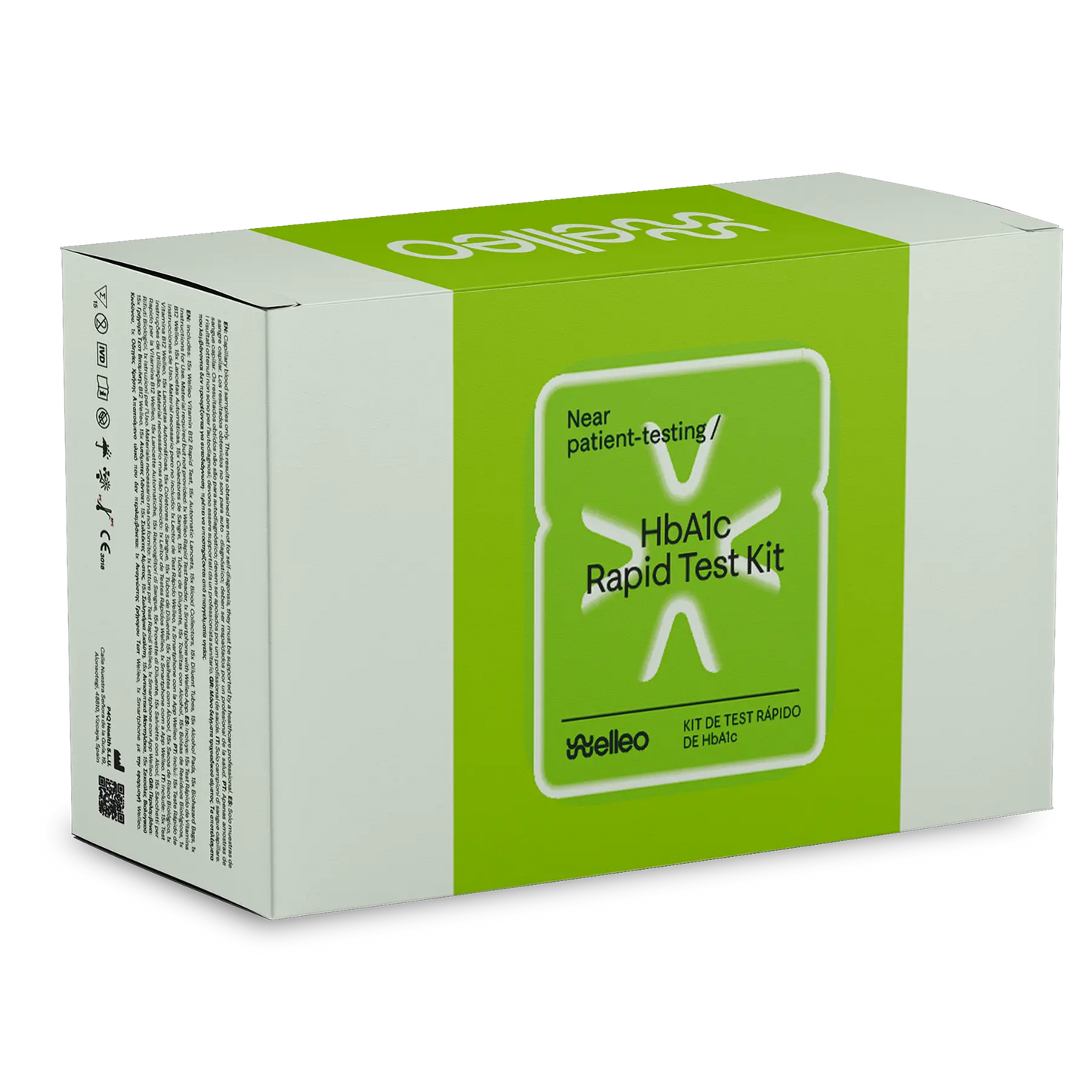
HbA1c Test

Monitor long‑term blood glucose control with HbA1c.

Duties and taxes included. Shipping calculated at checkout.
Only for Professional Use
The Welleo HbA1c test quantitatively measures glycated hemoglobin, reflecting average blood glucose levels over several weeks. Digital analysis supports diabetes monitoring and long‑term glucose control assessment.
View full details

Technical product

HbA1c Test

Description

Glycosylated hemoglobin is the product of the combination of hemoglobin in red blood cells and blood glucose in human blood. The combination of blood glucose and hemoglobin to produce glycosylated hemoglobin is an irreversible reaction, which is directly proportional to the blood glucose concentration and remains for about 120 days. The glycosylated hemoglobin test can usually reflect the blood glucose control of patients in recent 8-12 weeks, and is not affected by factors such as blood drawing time, fasting and insulin use.

Normal reference values: 4.0%-6.0%

Notice: Individual reference range is suggested to be established for each laboratory.

Intended use

This product is intended for vitro quantitative determination of Glycated Hemoglobin in human whole blood or peripheral blood samples.

This product is used in combination with the Welleo Lateral Flow Reader. Clinically, it is mainly used for auxiliary diagnosis of diabetes and monitoring of blood glucose level.

Principle

This kit uses immunofluorescence double antibody sandwich method to determine the ratio of glycosylated hemoglobin (HbA1c) in blood. Add the sample into the buffer solution, mix it evenly and drop it into the sample well of the detection card. The glycosylated hemoglobin (HbA1c) and hemoglobin (Hb) in the sample are respectively combined with the fluorescent microsphere labeled HbA1c monoclonal antibody 2 and Hb monoclonal antibody 2 in the fluorescent pad to form an sandwich complex, which diffuses forward along the nitrocellulose membrane under the action of capillarity. The complex is captured by HbA1c monoclonal antibody 1 and Hb monoclonal antibody 1 fixed on the nitrocellulose membrane, The concentration of HbA1c antigen and Hb antigen in blood is positively correlated with the fluorescence signal intensity. By the Immunofluorescence Analyzer, the ratio of HbA1c to Hb in the sample is calculated quantitatively according to the ratio of fluorescence signal and the calibration curve of the reagent.

Technical dossier

Laboratory and clinical details

Materials provided
  • Main components (ref. SF100255, SF100256, SF100257):
  • The product is mainly composed of the following items:
  • Test cartridge | 10 tests | 15 tests | 20 tests | Detector Buffer | 10 units | 15 units | 20 units | Whole blood sampler | 10 units | 15 units | 20 units | Lancet | 10 units | 15 units | 20 units | Alcohol pad | 10 units | 15 units | 20 units | Biohazard bag | 10 units | 15 units | 20 units | Instructions for use | 1 unit | 1 unit | 1 unit
  • Note: The components of the different batches of kits are not interchangeable.
Materials needed but not provided
  • - Welleo Lateral Flow Reader (ref. Q1A-DUO-USB)
  • - Centrifuge (for Plasma/Serum only)
  • - Transfer pipette set (100 μL size)
  • - Specimen Collection Containers
Sample collection and preparation
  1. The test can be performed using serum, plasma, whole blood, or peripheral blood specimens.
  2. Whole Blood Collected by Venipuncture
  3. - Collect a whole blood specimen via venipuncture using standard phlebotomy procedures. Use a blood collection tube containing a suitable anticoagulant (EDTA is recommended).
  4. - It is recommended to test specimens immediately after collection. Do not leave specimens at room temperature for extended periods. If immediate testing is not possible, specimens may be stored at 2°C to 8°C.
  5. - Whole blood specimens stored at 2°C to 8°C for more than 2 days are not suitable for testing.
  6. Serum and Plasma
  7. - Separate serum or plasma from the blood as soon as possible to avoid hemolysis.
  8. - Testing should be performed immediately after specimen collection. Do not leave specimens at room temperature for extended periods.
  9. - Specimens may be stored at 2°C to 8°C for up to 7 days. For long-term storage, specimens should be kept at below –20°C.
  10. Peripheral Blood
  11. - Clean the fingertip with an alcohol pad. Remove the lancet cap and press to puncture the skin. Gently squeeze the finger to obtain an adequate drop of blood, then collect the sample into the blood collection tube.
  12. - Peripheral blood specimens may be stored at 2°C to 8°C for up to 7 days. For long-term storage, specimens should be kept at below –20°C.
Storage and stability
  • - Store the detector buffer at 2~30℃. The buffer is stable up to 24 months.
  • - Store test kit at 2~30℃, shelf life is up to 24 months.
  • - Test Cartridge should be used within 60 minutes after opening the pack.
Test procedure
  1. Download the app from the Google Play Store or Apple Store and sign in with your credentials. If sign up is needed, please contact your distributor. For specific operation of the instrument, follow the instructions on the reader.
  2. Step 1: Preparation
  3. The test and blood sample should be balanced at room temperature before the test. Open the foil bag, take out the test card, and place it on a table.
  4. Press “+” button to start a new test, scan the QR code located in the test and follow the procedure. Select Patient ID, Sample ID, and sample type (if applicable).
  5. Step 2: Sampling
  6. Draw 10 μL of whole blood with a transfer pipette and add it to the buffer tube. If using whole blood sampler open the diluent tube by peeling off the foil at the top and insert the blood collector completely into the diluent liquid.
  7. Step 3: Mixing
  8. Mix well the specimen with buffer 10 times by tapping or inverting the tube and incubate for 1 minute.
  9. Step 4: Loading
  10. Take 75 μL of sample mixture and load it onto the sample well of the Test Cartridge. If using the whole blood sampler, place 3 drops in the sample well.
  11. Step 5: Testing
  12. Press Start Timer button and wait for the 5 minutes reaction time. A timer will be displayed on screen. The Welleo shall be connected to the Mobile App before this timer has expired.
  13. Insert the test into the Welleo. Once inserted, the animation on the Welleo App will change and you will be requested to extract the test at a constant speed. After some seconds, the test result will be displayed. If asked to repeat the reading, follow the feedback warning for proper action. If the test is not processed within 1 minute after the countdown concludes, the test will be considered invalid, and a new test must be used for retesting.
Quality control
  • This product used in conjunction with the Welleo Lateral Flow Reader contains internal control for routine quality control requirements. This internal control is carried out every time a patient sample is analyzed. This check indicates whether the test cartridge was inserted and read correctly using the Lateral Flow Reader. An invalid internal control result causes an error message in the analyzer indicating that the test should be repeated.
Performance characteristics
  • Blank detection limit
  • The blank detection limit ≤ 4.0%
  • Accuracy
  • The relative deviation (Bias) is within ±10.0%.
  • Linear range
  • The linear range of determination is between 4.0% and 14.0%, and the linear correlation coefficient (R) is ≥ 0.99.
  • Repeatability
  • The coefficient of variation within batch≤ 10.0%.
  • The coefficient of variation between batches ≤ 10.0%.
Precautions
- This kit is for in vitro diagnostic use only.
- Do not mix components from different kit lots.
- Do not use test kit beyond the expiration date.
- Do not use the Test Cartridge if the pouch is punctured or not well sealed.
- Blood specimens, used Test Cartridges, pipette tips and detector buffer vials should be handled and disposed in accordance with standard procedures and relevant regulations of microbiological hazard materials.
- The results should be interpreted by the physician along with clinical findings and other laboratory test results.
Limitations
- This kit is only for the detection of human whole blood samples.
- Triglyceride and bilirubin in the sample will interfere with the test results, and the maximum allowable concentrations are 25.0g/L and 0.1g/L, respectively. Exceeding the interference concentration and seriously polluting the sample may lead to wrong results.
- Due to technical reasons, operation errors and other sample factors, test results may be wrong.

How to use the Welleo tests