Skip to product information
1 of 1

Lipid Analyzer

Quantitative reader for lipid-profile assay workflows.

Duties and taxes included. Shipping calculated at checkout.
Only for Professional Use
Quantitative point-of-care reader for comprehensive lipid panel analysis. Delivers simultaneous TC, HDL-C, LDL-C, and Triglycerides results from a single capillary sample in minutes. For professional use in pharmacy and near-patient settings.
View full details

Technical product

Lipid Analyzer

Description

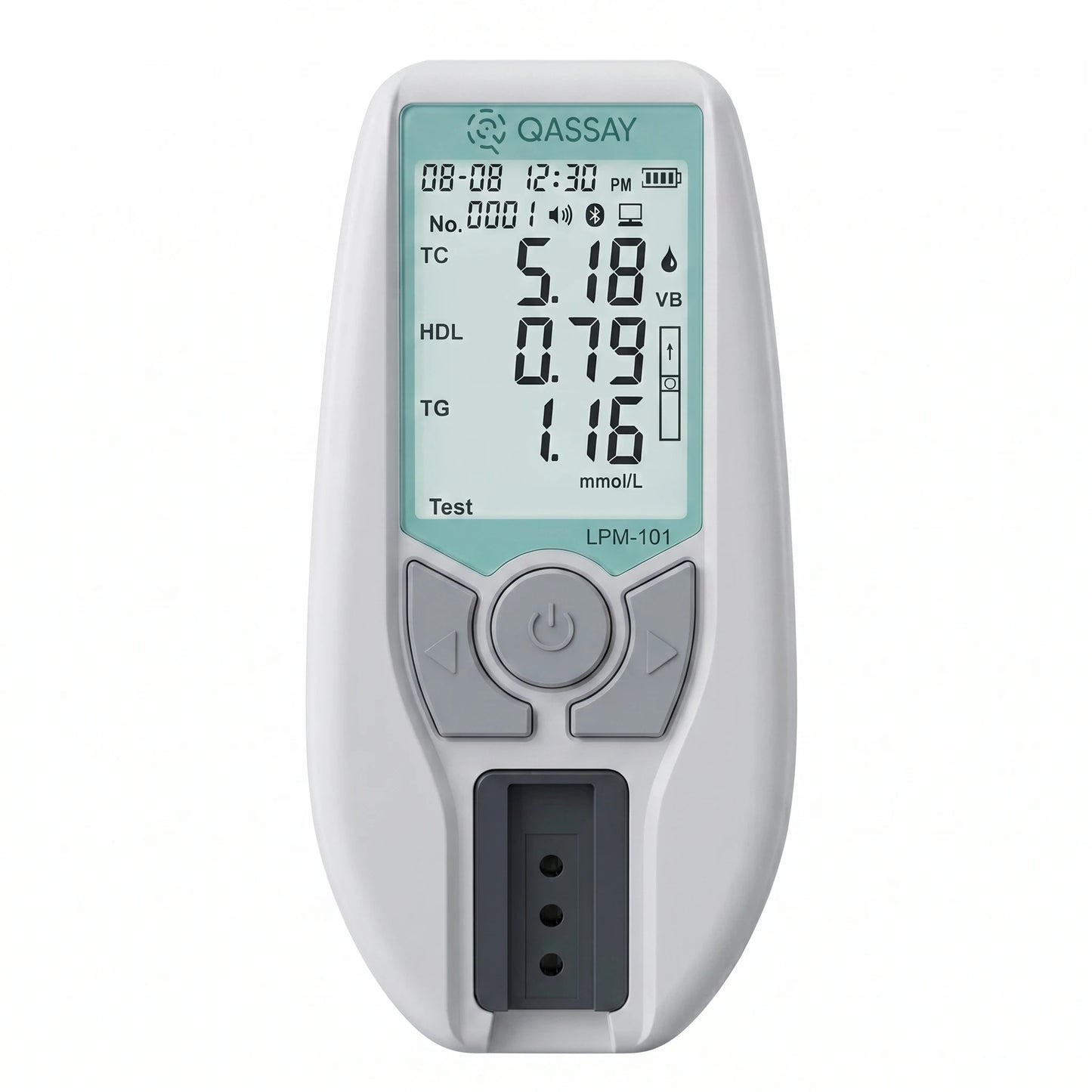
The Lipid Analyzer (LPM-101) is a dedicated point-of-care reader for quantitative lipid panel testing. Using 8-channel optical immunofluorescence with a controlled UV beam, it delivers simultaneous measurement of Total Cholesterol, HDL-C, Triglycerides, and a calculated LDL-C value from a single capillary blood sample.

Designed for pharmacy and near-patient workflows, the device eliminates subjective interpretation errors through repeatable optical calibration and synchronous multichannel signal processing — providing results comparable to laboratory standards at the point of care.

Intended use

Quantitative measurement of Total Cholesterol (TC), HDL-Cholesterol (HDL-C), LDL-Cholesterol (LDL-C, calculated), and Triglycerides (TG) from capillary blood, venous whole blood, or plasma/serum samples using the Qassay Lipid Profile test strip.

Indicated for cardiovascular risk stratification, lipid-lowering therapy initiation and monitoring, residual risk assessment, and pharmacy-led cardiometabolic follow-up programmes.

Principle

8-channel synchronous optical immunofluorescence with a controlled UV excitation beam. Each channel reads a distinct signal from the lateral flow strip, eliminating cross-channel interference and subjective visual interpretation.

TC, HDL-C, and Triglycerides are measured directly. LDL-C and TC/HDL ratio are calculated: LDL = TC − HDL − TG/5 (mg/dL) or LDL = TC − HDL − TG/2.2 (mmol/L).

Internal calibration runs automatically before each measurement to ensure a repeatable optical standard across sessions.

Technical dossier

Laboratory and clinical details

Components
  • Components The Blood Lipid Analysis Meter reads the test strips and displays the concentrations of TC, HDL, TG, or the calculated value of LDL and the ratio of TC/HDL. Use this diagram to become familiar with all the parts of the meter.
  • → USB Port No.000 /4) 82
  • + LCD Crystal Display (LCD)
  • TC VB HDL TG
  • + Left Key mmol/L Test LPM-101
  • + Power Key
  • + Right Key Code Chip Slot Test Strip Holder Meter use and precautions Do not get water or other liquids on or inside the meter.
Materials provided
  • Please check the following requirements when you first receive our products: Check the integrity of the delivery to ensure that the goods are not damaged or damaged. If you have any question,
  • please contact the manufacturer.
  • Before testing, read the instructions carefully and learn about all the components of the Blood Lipid Analysis System. Depending on the package type, some of the components may need to components are included with your purchase.
  • The following items are needed to perform a test:
  • 1. Blood Lipid Analysis Meter: Reads the test strips and displays the concentrations of TC,
  • HDL, TG and calculated LDL and TC/HDL values.
  • concentrations of TC, HDL, TG or calculated LDL and TC/HDL values.
  • 3. Safety Lancets: Used to draw blood specimens. Discard after use.
  • 4. Code Chip: Automatically calibrates the meter with the code number when inserted into the meter.
  • 5. Capillary Transfer Tubes: Collects capillary blood from fingertip blood testing for accurate results.
  • 6. USB Cable: Charge the meter.
  • 7. Carrying Case: Provides portability for testing.
  • 8. Instructions For Use: Provides detailed instructions on using the Blood Lipid Analysis System.
  • strips.
  • Disposable materials. Please use them before the expiration date.
Materials needed but not provided
  • Qassay Lipid Profile test strips (sold separately)
  • Capillary transfer tubes (included with test strips)
  • Lancet device
  • Alcohol swabs
  • Gloves
Sample collection and preparation
  1. Power on the Lipid Analyzer and wait for the internal calibration check to complete
  2. Select the correct sample mode: FB (capillary blood), VB (venous whole blood), or SP (plasma/serum)
  3. Collect the capillary blood sample — wipe the first drop, collect the second drop using the capillary transfer tube without squeezing
  4. Load the Lipid Profile test strip and apply the sample immediately
  5. Insert the strip into the analyzer without delay to minimise pre-analytical drift
  6. Analyse capillary samples immediately after collection — do not store a loaded strip
  7. If using refrigerated venous blood or plasma, equilibrate to operating temperature before measurement
  8. Do not use the device outside the stated operating temperature range specified in the LPM-101 Manual
Storage and stability
  • Storage and handling Store optical verify strips in a cool, dry place. Store away from heat and direct sunlight.
  • Replace the cap on the strip canister immediately after removing a strip. Expired strip may produce incorrect test results.
Test procedure
  1. Power on the Lipid Analyzer and confirm the internal calibration check has passed
  2. Select the sample mode: FB (capillary), VB (venous whole blood), or SP (plasma/serum)
  3. Prepare the Lipid Profile test strip — do not open until ready to use
  4. Collect the capillary blood sample following the sample collection protocol
  5. Apply the sample to the strip immediately and insert into the analyzer
  6. Wait for the result readout — the device displays TC, HDL-C, LDL-C, TG, and TC/HDL ratio
  7. Review results against reference intervals; document fasting status and sample mode in the patient record
  8. Repeat unexpectedly extreme values; confirm with venous laboratory testing when results are near treatment thresholds or conflict with the clinical picture
Quality control
  • Confirm the internal calibration check passes before every testing session
  • Repeat unexpectedly extreme values before taking clinical action
  • Confirm with venous laboratory testing when results are near major treatment thresholds
  • Confirm with laboratory testing when triglycerides are markedly elevated — Friedewald LDL-C accuracy decreases at high TG
  • Document QC runs in accordance with your laboratory's quality management procedures
Performance characteristics
  • Meter can not be tested until it is charged.
  • E-6 Code chip was removed.
  • Insert proper code chip. Confirm the code chip matches the test strip code and repeat the test.
  • E-7 The environment Get the meter in a proper environment temperature is higher than 35℃
  • where the temperature is between 10-35℃.
  • or lower than 10C.
  • HI The result is higher than the Retest with a new strip and contact limited.
  • your doctor.
  • Lo The result is lower than the limited.
  • 14. Meter Performance The Accuracy Item Range of sample Bias TC 2.59mmol/L-5.17mmol/L (100mg/dL-200mg/dL)
  • ≤±1.03mmol/L
  • (±40mg/dL)
  • 5.18mmol/L-12.93mmol/L (201mg/dL-500mg/dL)
  • ≤±20%
  • HDL 0.39mmol/L-0.78mmol/L (15mg/dL-30mg/dL)
  • ≤±0.16mmol/L
  • (±6mg/dL)
  • 0.79mmol/L-2.59mmol/L (31mg/dL-100mg/dL)
  • ≤±20%
  • TG 0.51mmol/L-1.13mmol/L (45mg/dL-100mg/dL)
  • ≤±0.23mmol/L
  • (±20mg/dL)
  • 1.14mmol/L-7.34mmol/L (101mg/dL-650mg/dL)
  • ≤±20%
  • The Precision Item Range of sample SD TC 2.59mmol/L-5.17mmol/L(100mg/dL-200mg/dL)
  • SD<0.39mmol/L
  • (<15.1mg/dL)
  • 5.18mmol/L-12.93mmol/L(201mg/dL-500mg/dL)
  • CV<7.5%
  • HDL 0.39mmol/L-0.78mmol/L (15mg/dL-30mg/dL)
  • SD<0.06mmol/L
  • (<2.3mg/dL)
  • 0.79mmol/L-2.59mmol/L(31mg/dL-100mg/dL)
  • CV<7.5%
  • TG 0.51mmol/L-1.13mmol/L(45mg/dL-100mg/dL)
  • SD<0.08mmol/L
  • (<7.5mg/dL)
  • 1.14mmol/L-7.34mmol/L(101mg/dL-650mg/dL)
  • CV<7.5%
Precautions
For professional use only. Not intended for self-testing by the general public.

High uric acid or high ascorbic acid concentrations may produce falsely lower TC, HDL-C, or TG measurements.

Nonfasting testing is acceptable for most routine risk assessment. Fasting is reserved for very high TG scenarios or when result interpretation is unclear.

Treatment decisions must integrate medical history, comorbidities, current medications, and local guideline requirements. Do not act on point-of-care results alone.

Use only with Qassay Lipid Profile test strips. Do not use strips from other manufacturers.
Limitations
LDL-C is a calculated value using the Friedewald-derived formula. Accuracy decreases at high triglyceride concentrations — confirm with a direct LDL-C assay when TG is markedly elevated.

This device does not replace comprehensive laboratory evaluation where clinically indicated.

Refer to the LPM-101 Manual for full interference tables, operating limits, and contraindications.

How to use the Welleo tests